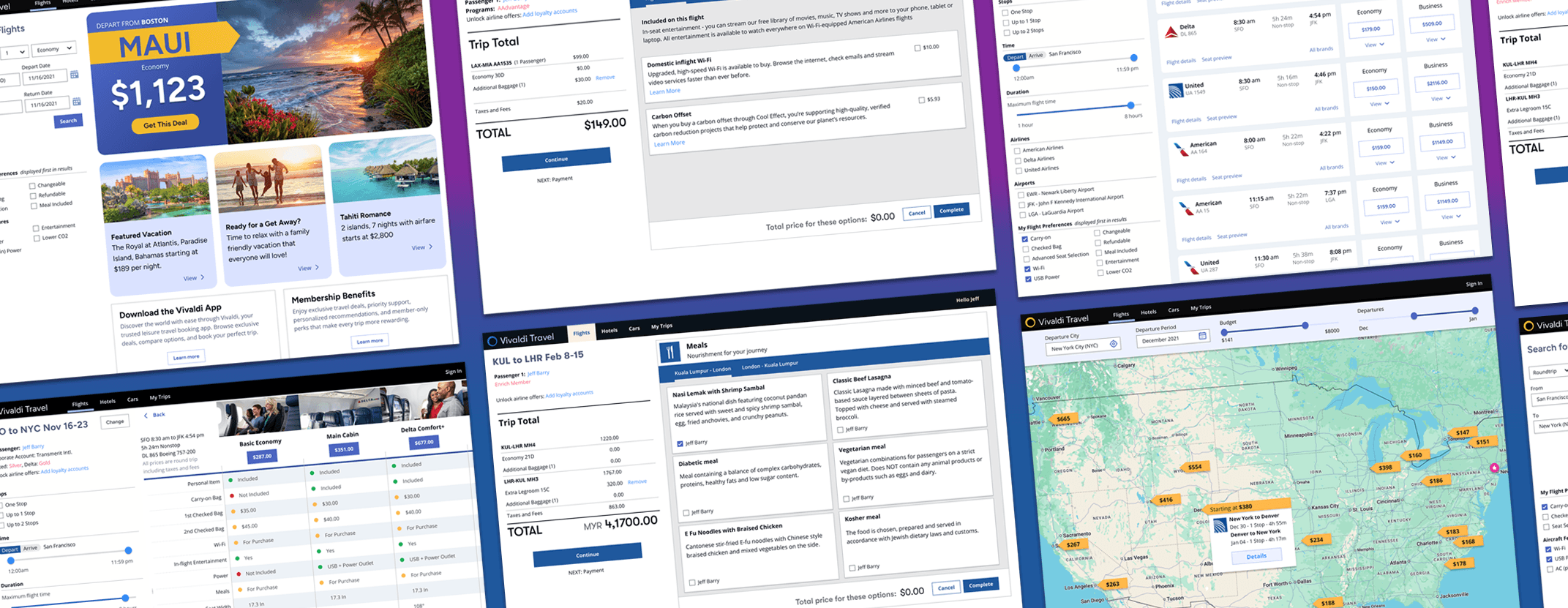
In 2020, Travelport began a multi-year effort to modernize the agency point-of-sale experience; transitioning from legacy fare distribution to an API-driven retailing platform. Through extensive research with airlines, OTAs, and corporate agencies, the team reimagined flight shopping around value over price, introducing attribute-led search, shelf-based comparisons, and transparent bundles that empowered agencies to control how they retail. The result was a content-agnostic platform that transformed legacy distribution into a flexible, modern retailing experience.This became the foundation of Travelport’s Dynamic Retailing Platform, unifying ATPCO, NDC, and low-cost carrier content under one open API and giving agencies full control of how they retail flights
Context
Airline retailing was rapidly changing. Carriers were introducing branded fares, ancillaries, and dynamic pricing through new NDC APIs while agency tools still displayed fares as if it were 1999. At the same time, the ATPCO's NextGen Storefront proposed a universal “shelf” standard for comparing brands. But carriers and agencies pushed back on its rigid, one-size-fits-all algorithm.Travelport saw an opportunity: design a better storefront experience that could adapt to each agency’s needs, integrate multi-source content, and modernize indirect retailing to match the sophistication of airline direct sites.
Rebuttal
A major U.S. carrier and ATPCO (Airline Tariff Publishing Company) introduced their Next Gen Storefront (NGS): a proposal to standardize fare comparisons through a universal “Shelves & Drawers” model. The goal was admirable: make it easier for travelers to compare branded fares across carriers. But the execution reflected a narrow, U.S.-centric view of the market. The NGS algorithm prioritized seat pitch as the primary measure of value, a metric many global carriers rejected as irrelevant to their brand differentiation.
Problem
Legacy GDS logic was built around price-first shopping, not value-first retailing.
Agents were rewarded for speed, not upselling
Airline direct sites were outpacing the indirect channel in merchandising.
Agencies lacked control over how content was displayed.
The industry lacked a standard for comparing rich, multi-source offers.
Without a viable modernization path, Travelport risked losing relevance in a market shifting toward API-based distribution and personalized retail experiences.
Timeline
The goal was ambitious — deliver a coded MVP of Agent Storefront within six months. The roadmap aligned design and engineering milestones across three Program Increments (PIs) under SAFe.
PI10 (End Apr 9): Kickoff workshop and discovery readout; wireframes and stakeholder validation sessions with key airline, OTA, and agency partners.
PI11 (End Jun 18): Build and test high-fidelity prototypes with travelers; begin foundational coding for the Storefront API; conduct Stage 2 usability testing.
PI12 (End Aug 27): Complete MVP coding and prepare for integrated testing with Trip Services and Smartpoint Cloud.
Discovery
I began by mapping the evolving ecosystem speaking with more than 50 industry participants, including airlines (AF/KLM, Emirates, Etihad, Aegean, Gulf Air, Delta, American), OTAs (Priceline, Ctrip), and corporate agencies (Amex GBT, Click Travel, Deem).
Workshops, prototype testing, and ethnographic studies revealed shared pain points:•
Agencies wanted control and flexibility (“our customer is our customer, not the airline”).
Airlines wanted fair brand representation and dynamic bundles.
Travelers wanted clarity—to understand what’s included without hidden fees.
The proposed Next Gen Storefront (NGS) algorithm prioritized seat pitch as the primary measure of value, a metric many global carriers rejected as irrelevant to their brand differentiation.
As a team we agreed that our response was to build flexibility, not conformity. The Agent Storefront would embrace the good in NGS (clearer comparisons and upsell visibility) but fix what it got wrong by letting agencies define their own shelf logic. Instead of one global algorithm, we wanted to validate that an attribute-led, content-agnostic framework could adapt to any market, content source, or traveler type. This approach would re-centered control where it belongs: with the agencies serving travelers, supported by carrier data (not dictated by it).
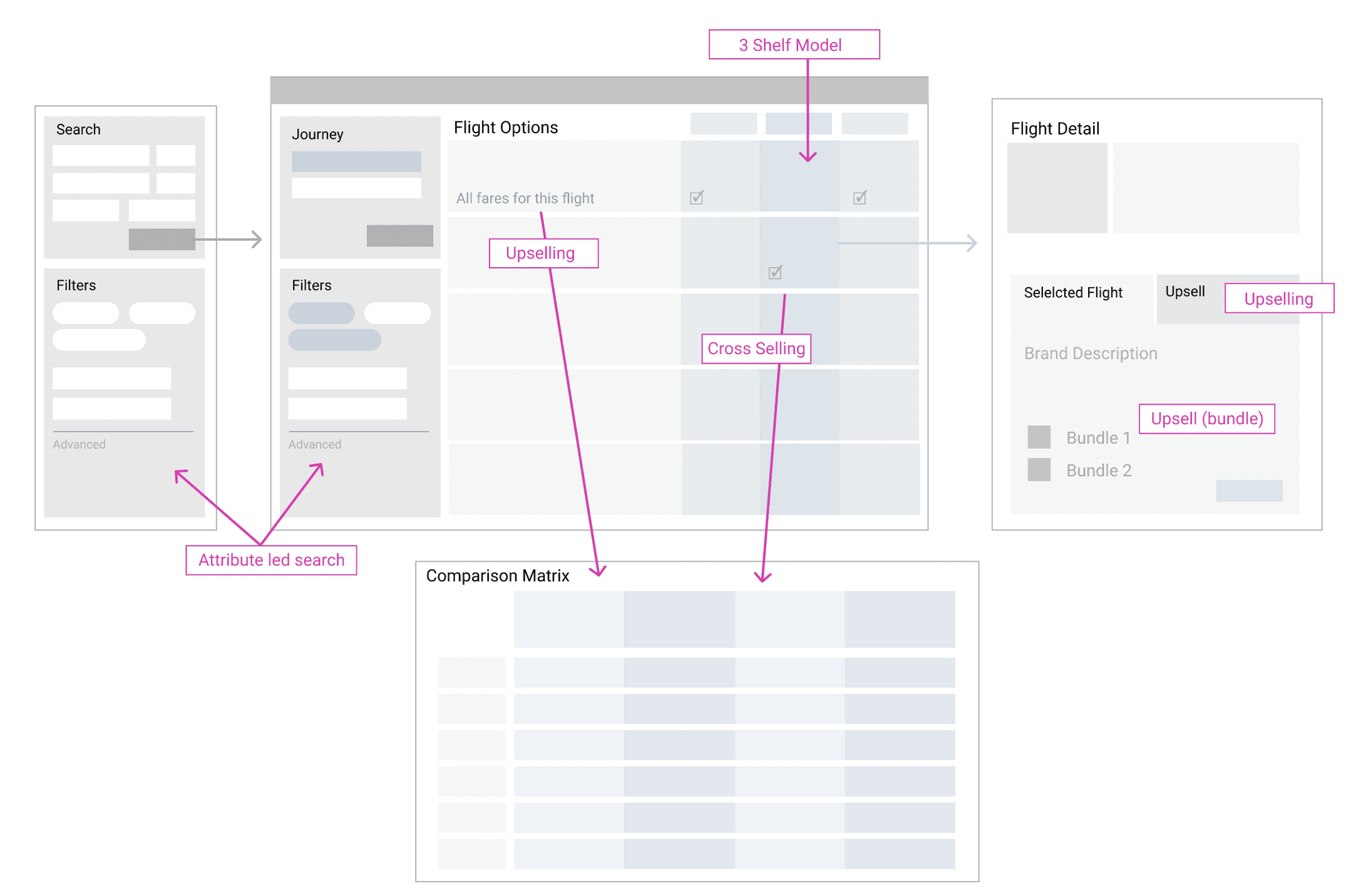
Above: Wireframes highlighting upsell opportunities
Research Focus
Key methods:
- Usability testing
- Stakeholder interviews and agency A/B feedback
- Concept validation with travelers and booking tool providers
- Internal design sprints aligned to SAFe PI cycles
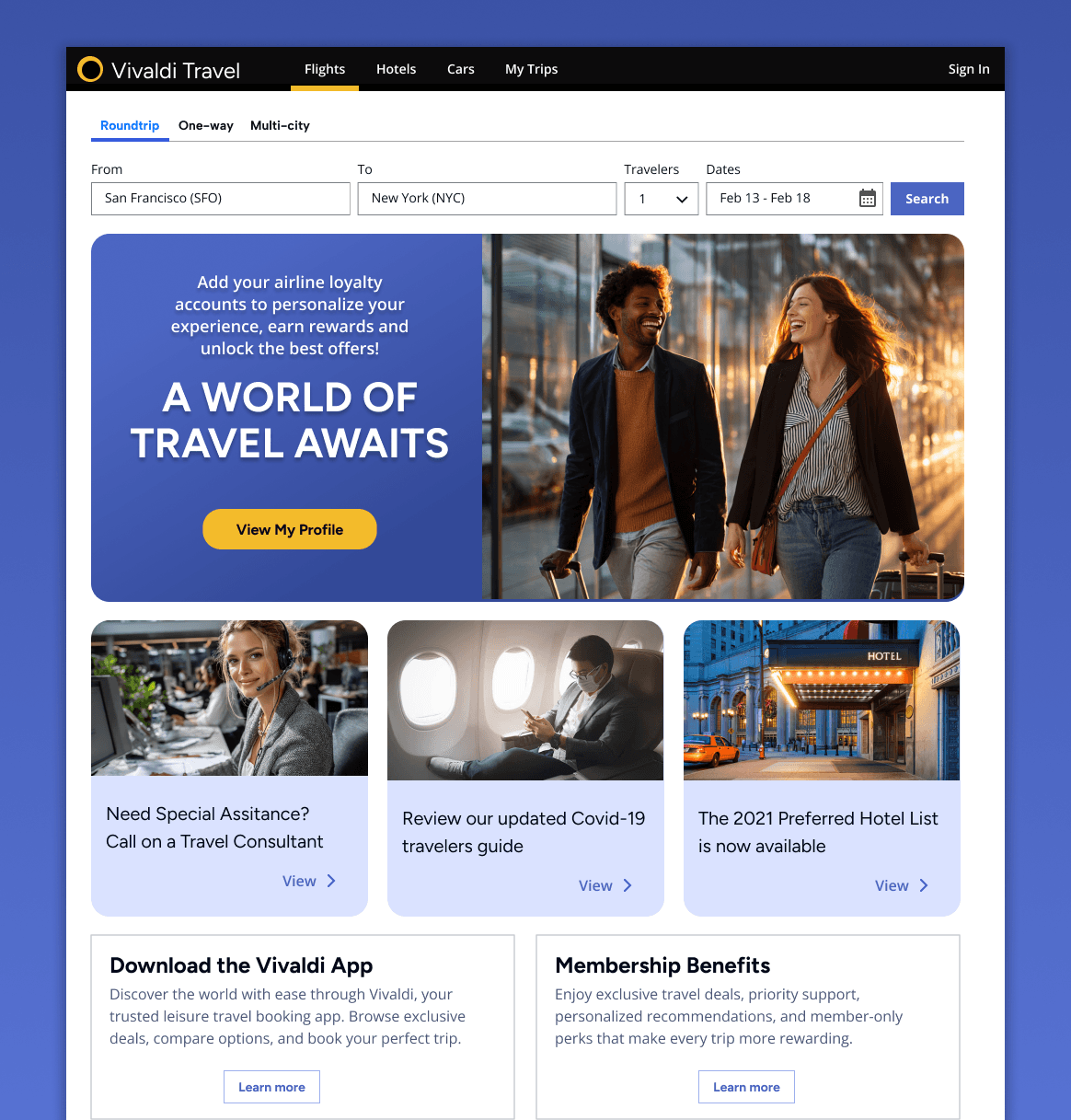
Above: Vivaldi is our Travel Management Company persona
Design Strategy
We shifted the paradigm from price-based search to value-based retailing:
Attribute-led Search: Agents could filter results by amenities, refundability, or policy compliance.
"Just Right” Algorithm: Ranked offers by best value, not lowest fare.
Shelves & Drawers: Flexible comparison categories adaptable by market or customer type.
Cross-Airline Matrix: Unified brand comparison across carriers, with transparent inclusions.
Bundles & Upsells: Clear, dynamic product packaging with loyalty tier personalization.
Split Ticketing: Multi-carrier, multi-leg combinations optimized by cost and value.
Each prototype was tested with agents and travelers to refine clarity, discoverability, and trust.
Impact
While detailed migration data remains proprietary, adoption of the Travelport+ Retailing APIs is healthy, with positive feedback from both agencies and carriers signaling strong market traction. Early agency adopters like Skylord Travel reported measurable business impact — “Since adopting it, they have seen a 50% increase in volumes, depending on the destination and types of upsells available.” On the supplier side, American Airlines’ Senior Vice President noted that “Travelport was first over the line with a proven NDC solution, and that’s made it easy for us – and for agencies – to be modern retailers.”
Across the ecosystem, sentiment toward Travelport’s unified retailing vision has been encouraging. Agencies welcome the ability to compare and sell multi-source content side by side, while the launch of Smartpoint Cloud has extended these capabilities into an intuitive, web-based environment. As Christopherson Business Travel observed, “Smartpoint Cloud allows our agents to have access to all travel content, including NDC, in a modern web-based interface … This will be a game changer.”
Together, these advances mark a significant step in modernizing agency retailing—bridging legacy systems, supplier diversity, and contemporary UX expectations into a cohesive, future-ready platform
Industry Recognition: Travelport established itself as a thought leader in retailing modernization.
Strategic Alignment: Storefront became a core pillar of the Dynamic Retailing Platform roadmap and Smartpoint modernization.
Design Legacy: UX research from this initiative influenced subsequent projects in NDC Fare Management, Adaptive POS, and Dynamic Bundling.
Reflections
The Retail Storefront project redefined how indirect travel channels think about retailing. By blending UX research, technical feasibility, and business alignment, we built not just a product—but a platform vision: content-agnostic, data-driven, and user-controlled retailing.


