
Designing Sustainability into travel retail
How might we provide travel agencies with clear, credible, and standardized sustainability information—such as CO₂ emissions and hotel certifications—so they can help their corporate customers meet sustainability goals, influence traveler choice at the point of sale, and build trust in Travelport as a partner in sustainable travel?
Context
This was a high-visibility initiative, spearheaded by the VP of Product and led by the VP of Emerging Business. It required gathering cross-stream input from Retail API, engineering leadership, and product management to align strategy and execution.
The effort kicked off with a market report I authored: 'Sustainability and Product Strategy.' The purpose of the report was to shape Travelport’s stance on the sustainability challenge within the travel industry and influence product strategy. Its objectives were to:
Understand the driving forces for greater sustainability in travel.
Analyze how different industries are responding and identify areas of consensus and leadership.
Inform internal discussions on how Travelport could incorporate sustainability into its product portfolio.
This foundation helped secure leadership alignment and board-level commitment to sustainability features within the company. Travelport joined Travalyst, a sustainability coalition founded by Prince Harry and backed by leading travel and tech companies, working to standardize how the industry reports CO₂ emissions to help travelers make more sustainable choices. The Travel Impact Model (TIM), became the foundation for our product work.
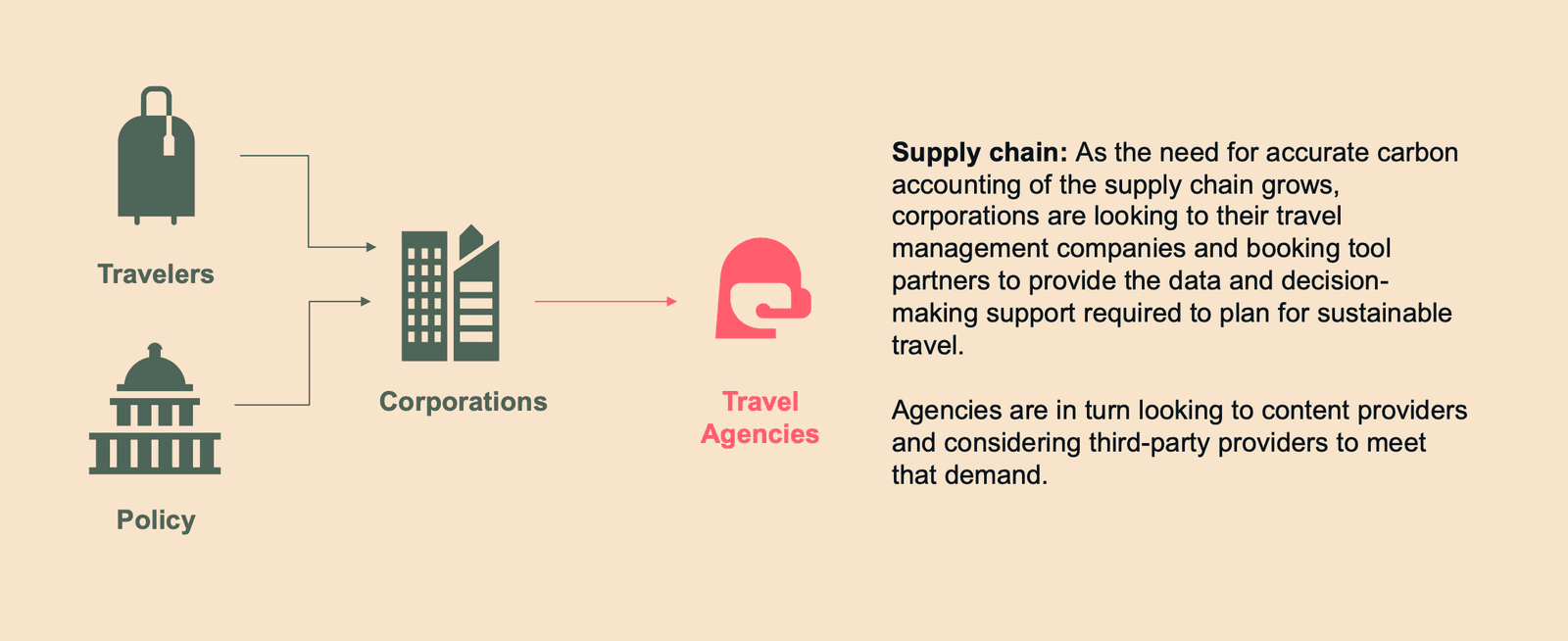
Above: Strategy Research Report: How might we help agencies meet the scope 3 emission targets of their customers?
Role
Retail Design Lead: I led the UX strategy and design for surfacing sustainability information in Travelport’s Point of Sale product. My focus was on balancing retail clarity with regulatory requirements, corporate sustainability goals, and agent usability.
Objectives
Introduce CO₂ emissions data into Smartpoint Cloud’s flight search results.
Enable comparison against median route emissions, to provide meaningful context.
Provide filters and sort orders to help agents act on sustainability preferences.
Create explainer content that builds trust by showing how calculations are made.
Deliver an MVP for flights that could later expand to hotels, car, and rail.
Process
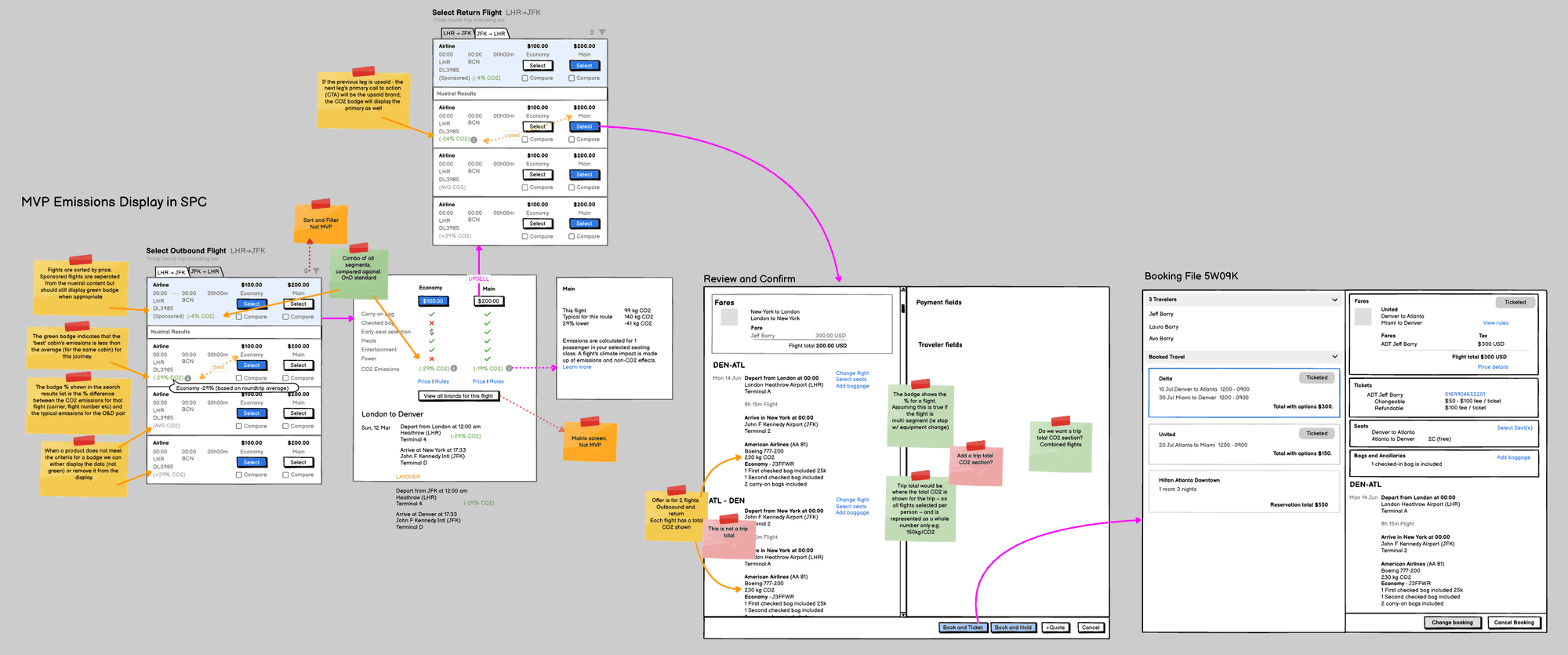
Process
To ensure our approach was competitive and credible, I conducted a market assessment of sustainability UX patterns, drawing from coalition partners and industry leaders. This gave us a benchmark for how emissions could be displayed, compared, and explained in ways agents and travelers would understand.
With this foundation, we explored multiple design directions:
Visual indicators, such as badges and percentage variance against average route emissions, to make sustainable flights easily identifiable.
Carbon metrics to support transparency in comparison shopping.
Interaction patterns for filtering and sorting by emissions, enabling agents to prioritize sustainability alongside price and schedule.
Research
I the conducted a remote usability study on UserTesting.com with five participants using a Figma prototype. The sessions focused on evaluating comprehension of CO₂ indicators, the clarity of variance metrics, and the ease of using sort and filter controls. The study validated core design assumptions while also highlighting opportunities to refine terminology and adjust the placement of indicators for improved clarity and usability.
At this stage, the MVP design was finalized and delivered, establishing the foundation for sustainable “nudges” in the booking experience. I collaborated with the product and development leads to review design artifacts, contributed to writing the feature’s Jira tickets, and participated in design approval prior to release.
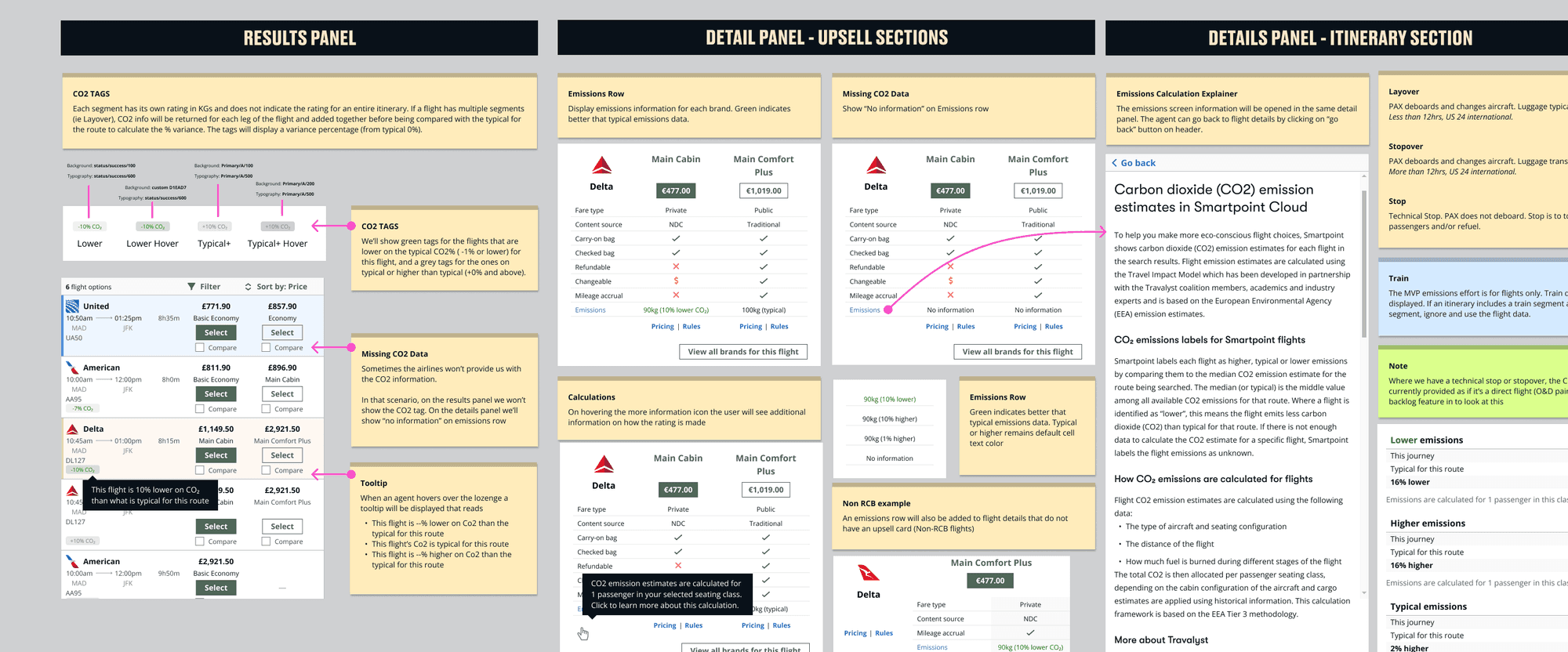
Delivery
At this stage, the MVP design was finalized and delivered, establishing the foundation for sustainable “nudges” in the booking experience. I collaborated with the product and development leads to review design artifacts, contributed to writing the feature’s Jira tickets, and participated in design approval prior to release.
Impact
Travelport has introduced POS-facing carbon-emission estimators via Travelport+ (leveraging the Travel Impact Model) which has been welcomed as a positive step by agents and corporate travel managers seeking greater transparency; however, as with most emerging sustainability tools in travel retailing, broader feedback on live adoption and shopper/agency behaviour remains limited and the industry continues to refine how such data supports actionable choices.
This high-visibility initiative showed how design leadership can help shape strategy. Design played a key role in aligning regulatory, technical, and commercial needs. As design lead and retail SME, I guided the team in shaping how sustainability information could be understood, trusted, and acted upon at the point of sale.
I ensured that sustainability was not treated as a “nice to have” but as a core retail attribute. Agencies can now meet their corporate customers’ sustainability expectations, and Travelport has established itself as a credible actor in helping the industry transition toward more sustainable travel.
Achieved Goal: Delivered standardized CO₂ flight data in SPC, aligned with Travalyst methodology and corporate reporting needs.
Market Fit: Enabled agencies to respond credibly to corporate sustainability RFPs.
User Benefit: Agents can now guide travelers to more sustainable options without adding friction to the booking process.
Strategic Value: Positioned Travelport as a sustainability partner, not just a data provider.
Whats next? This project surfaces a series of next steps that include Introducing hotel sustainability certifications (Green Key), Integrate emissions data for multi-modal comparisons for Rail & Car, Expand reporting features to support corporate carbon budgets and disclosure, and Explore carbon compensation as an ancillary add-on.


